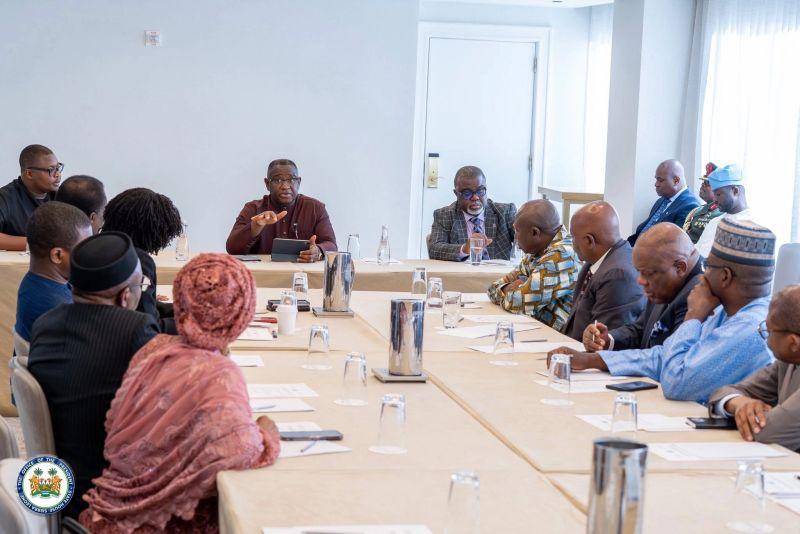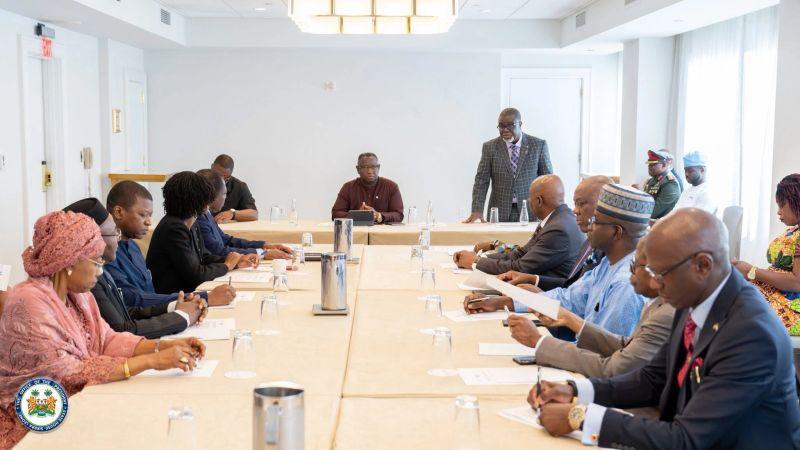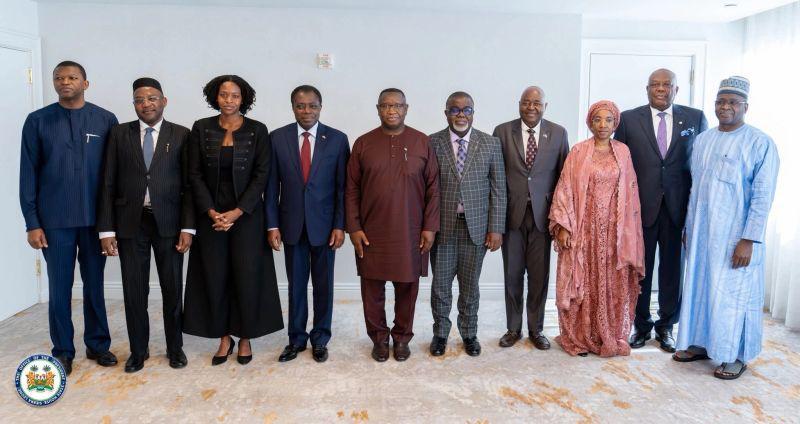
Washington D.C. October 23, 2025: On the sidelines of the 80th United Nations General Assembly, a high-level working session brought together the President of the Republic of Sierra Leone and current Chairman of ECOWAS, Julius Maada Bio, with the group of ECOWAS ambassadors accredited to the United States. This meeting, held in Washington, D.C., on Wednesday, October 1, 2025, provided an opportunity to examine in-depth the sociopolitical and security situation in the West African Community.
The Ambassador of Togo to the United States and dean of the Group, Frédéric Edem Hégbé, praised President Bio’s continued commitment to stability and peace in the subregion. He also reaffirmed the commitment of West African diplomats to support ECOWAS initiatives. “We are firmly committed to implementing all diplomatic decisions from the Conference of Heads of State and Government,” said Ambassador Hégbé.
For his part, President Maada Bio reiterated the founding principles of ECOWAS: economic integration, the free movement of people and goods, and solidarity among member states. He expressed his determination to strengthen regional unity during his term, emphasizing the importance of anticipating future changes, particularly those related to the fourth technological revolution.
“It is time to invest massively in technological innovation to provide our youth with the tools to shape their future,” he urged.
Withdrawal of the ESA from ECOWAS discussed
The issue of the withdrawal of the three countries of the Alliance of Sahel States (ESA) from ECOWAS was also a central topic of discussion. President Bio emphasized the importance of maintaining constructive dialogue with Burkina Faso, Mali, and Niger, which have been severely affected by insecurity and recurring terrorist attacks.
“No state is immune to terrorism. A regional coalition may be necessary to address this common threat,” he stated.
While acknowledging the political reality of the AES, President Bio called for an inclusive approach, believing that ECOWAS should consider formal dialogue with the AES as a separate political entity, rather than as three isolated states.
“The creation of the AES does not geographically remove Burkina Faso, Mali, and Niger from our common space. West Africa remains a whole, united by history, geography, and the aspirations of our peoples,” he insisted. In a spirit of openness, he announced his intention to initiate a diplomatic meeting with the leaders of the AES to present ECOWAS’s strategic agenda and explore avenues for a rapprochement that would benefit the entire region.